
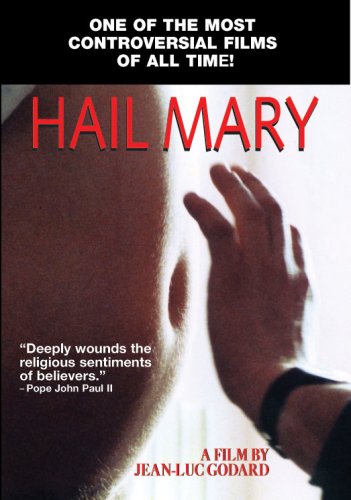
Jean-Luc Godard's Hail Mary (1985), often preceded by Anne-Marie Miéville's short film The Book of Mary, is a bold, modern-day retelling of the Virgin Birth. Set in contemporary Switzerland, Mary is a basketball-playing gas station attendant and Joseph a frustrated taxi driver. The film strips away traditional iconography in favour of a raw, visceral exploration of faith and bodily autonomy.
Running parallel to this narrative is a subplot involving a science professor and his student/lover — a secular counterpoint to the miracle — that contrasts the divine mystery of Mary's pregnancy with cold scientific inquiry into the origins of life, foregrounding the tension between what we can explain and what we cannot.
The parallel plot, however, proved genuinely confusing on first viewing. My mind was trying to determine how these characters were connected to Mary and Joseph, only to later realize the link is purely thematic. Without that being established early, the subplot feels more like a distraction than a complement. Gabriel, too, is a jarring presence; at one point he essentially barks at Joseph, "Love her, you jerk!" — and violently manhandles him. It didn't work for me. It felt out of step with the gravity of everything around it.
As a Canadian watching a French-European production, I found myself responding with a certain familiarity — something in the pacing, the sensibility, and mid-eighties settings. And the dialogue served as a welcome refresher for my French. True, the editing did seem a bit chaotic at times. But given Godard's affluent background and penchant for erudition, I imagine the disjointedness had some deep Platonic "Form / Content" significance.
The performances were impressive, especially in The Book of Mary. Rebecca Hampton, playing the young Mary navigating her parents' separation, is outstanding — her scenes quietly anchor the whole experience. The young child in the main feature, whom Godard cautiously frames as a parallel to Jesus, is also remarkably convincing. The intellectual subplots are another matter. The professor's ruminations on intelligent design and extraterrestrial seeding may have carried some novelty in the mid-eighties; today they feel dated and are, frankly, close to tedious.

My reaction to the film's nudity followed its own arc. The first scene featuring the adult Mary (Myriem Roussel) left me uncomfortable — it seemed voyeuristic, as though I were seeing something I had no right to see. I feel that seeing a woman unclothed should be a gift or blessing earned through genuine relationship, and in that moment the film felt little better than a soft-porn magazine. But as it progressed, my perspective shifted. I began to understand that Mary's body was not incidental — it was central to the miracle, the very site where the human and the divine intersected. I recalled that Pope John Paul II famously condemned the film, and found myself wondering whether that reaction arose partly from a religious repression of the shadow and a long-standing tendency to treat women's bodies as inherently suspect and shameful.
By the end, I had come around to seeing those scenes as more thought-provoking than disappointing. This shift also prompted a question about Roussel herself — did she go on to a substantive career, or was she simply filmed while young and physically striking, then quietly abandoned? Fortunately, she built a respectable body of work in European cinema, though critics say this remains her most daring and haunting performance.
Hail Mary is worth the effort if you can sit with religious themes handled in deliberately provocative, unconventional ways — including awkward passages and nudity that force a confrontation with the place where the holy meets the human.
Comments
Post a Comment
All comments are moderated. No spam, commercial links, or legally actionable content. Thank you for keeping it relevant.